
Home »Programs »Volcanoes Journey and Expeditions »Cerro Marmolejo Expedition
Cerro Marmolejo Expedition

Cerro Marmolejo Expedition

At the far end of the Cajón del Maipo, a few hours from Santiago, an eight-day expedition to Cerro Marmolejo, regarded as the southernmost six-thousander in the world.

from
CLP$ 2.200.000
per person
Cajón del Maipo, Metropolitan Region
8 days
Duration
2 – 8 pax
Group
1 guide per 3 clients
Guide ratio
Start / End
Santiago, Región Metropolitana
Season
All year round
Difficulty
Max. altitude
6,108 m
Distance
±48 km round trip
Elevation gain
+3,800 m

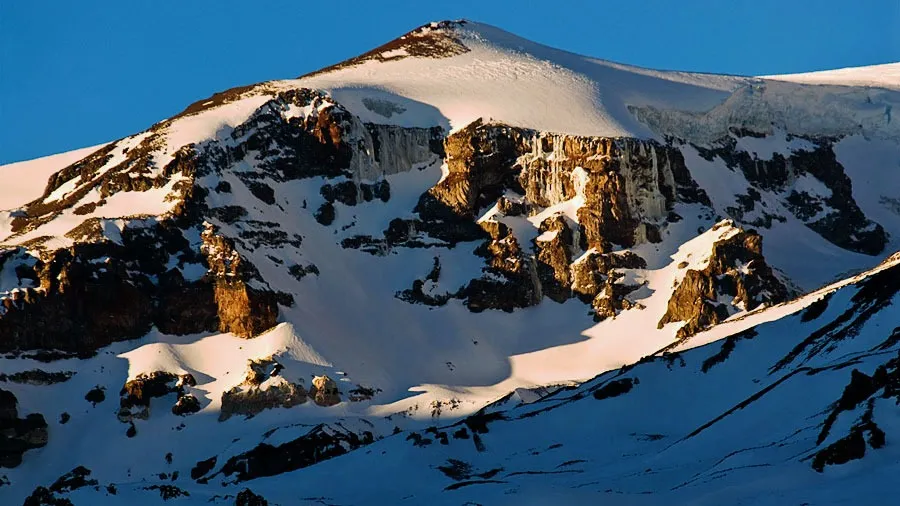
Cerro Marmolejo (6,108 m) rises on the border with Argentina and is one of the most accessible high-altitude expeditions in the Andes, without losing what matters most: the silence of the mountain valleys, camp life and the isolation of the high mountains.

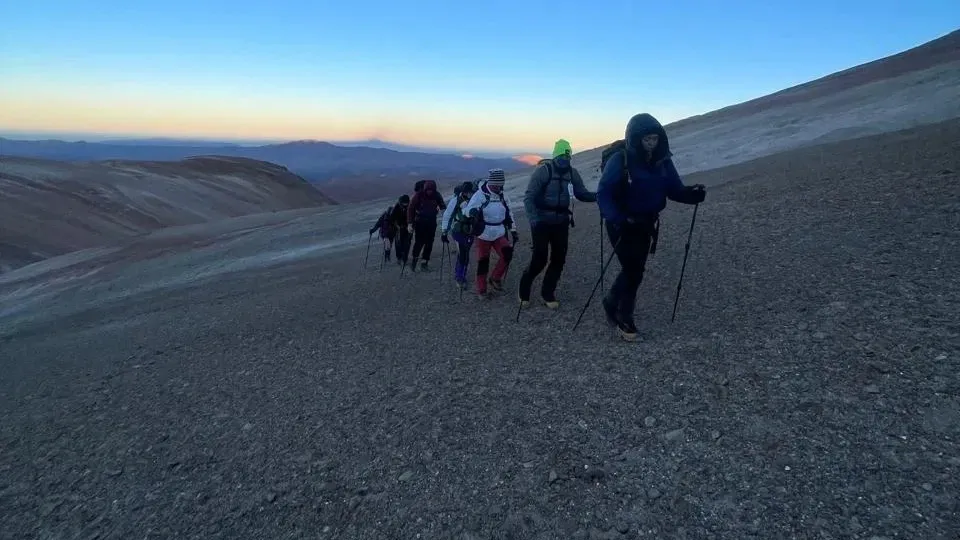
We will leave Santiago for El Cabrerío (~2,350 m), where the road ends. There we will load the mules, which will carry the gear to base camp (between 3,300 and 3,600 m), and begin the approach on foot: some 10 to 11 km through the La Engorda valley and the Estero Marmolejo area, with stream crossings and stretches of scree and loose rock.

From base camp we will move up progressively: a first camp on a plateau with stone walls (pircas), between 4,100 and 4,300 m, with the first direct view of the massif, and a second at the edge of the Marmolejo glacier, between 4,800 and 4,900 m. The rotations let us acclimatise while we carry loads between camps. It is the rhythm of a classic expedition: climb, rest and climb again, giving the body the time it needs to adapt to altitude. Camp life is shared: we don't work with cooks, and guides and participants prepare breakfasts and dinners together.

The summit attempt is a long glacier crossing among penitentes and crevasses, which we will plan together according to how the group's acclimatisation has progressed, the forecast and the state of the route. The program allows eight days, one of them for contingencies, to leave a margin for mountain weather. It is a demanding expedition, designed for those who already have experience of multi-day camping trips and of altitude, and an excellent preparation for bigger objectives in the Andes.
  • Weather conditions. Cerro Marmolejo lies in the dry sector of the Central Andes. Summer is generally dry and relatively stable, although conditions can change quickly. The altitude brings intense cold, large day-to-night temperature swings and very strong solar radiation. Westerly winds are also characteristic and can be intense on exposed terrain. In autumn and winter, Pacific weather systems can bring snow to the mountain; wind, snowfall and ice can also occur at other times of year.
  • Bilingual mountain guide (ES/EN), member of ANGM Chile and registered with SERNATUR
  • Transport Santiago–El Cabrerío–Santiago
  • Mules to carry loads to base camp and back, subject to capacity and operating conditions
  • Camps with tents and cooking equipment
  • Collective safety equipment as required (ropes, first-aid kit and communications)
  • Camp meals (breakfasts and dinners), prepared by guides and participants, no cook
  • Complementary accident insurance
Not included: Sleeping bag, sleeping mat, personal technical equipment required for the route, high-altitude clothing and double mountaineering boots · Porter (optional extra at additional cost) · Meals other than those expressly included · Personal life, travel-assistance, medical, evacuation or repatriation insurance · Tips, personal expenses and any service not expressly stated as included
Day 1
Santiago – El Cabrerío (~2,350 m) – Base camp (3,300–3,600 m)Transfer from Santiago to El Cabrerío, where we load the mules. Approach on foot of 10 to 11 km (5 to 8 hours) through the La Engorda valley and the Estero Marmolejo area, with stream crossings, which we try to make early when the flow is lower, and a long trail over loose rock. We set up base camp.
Day 2
Base camp – Camp 1 (4,100–4,300 m)We climb a ridge of reddish scree to a plateau with stone walls (pircas), with the first direct view of the massif. Between 4 and 6 hours, carrying the loads for the next stages.
Day 3
Acclimatisation rotation towards Camp 2 (4,800–4,900 m)We carry loads up the rocky spine and return to sleep at Camp 1.
Day 4
Camp 1 – Camp 2 (4,800–4,900 m)We move camp up the rocky spine to the edge of the Marmolejo glacier, in 4 to 5 hours.
Day 5
Acclimatisation and preparationRest day, equipment check and planning of the summit attempt.
Day 6
Summit attempt on Cerro Marmolejo (6,108 m)Glacier crossing among penitentes and crevasses to the summit, returning to Camp 2, or to Camp 1 if the group is in good shape. A 9 to 12 hour day, starting before dawn, depending on the group's acclimatisation, the forecast and the state of the route.
Day 7
Descent to El Cabrerío and return to SantiagoFrom Camp 1, descent by the same route to base camp, where we load the mules, and on to El Cabrerío for the transfer to Santiago. It is a long day. If we spent the previous night at Camp 2, the descent takes two days.
Day 8
Contingency dayA margin to wait for a good-weather window, adjust the pace or complete the descent in two days. If it is not needed, the program ends on day 7.
Cancellation policy
Cancellations up to 45 days before the start: refund of the amount paid, less the reservation fee and any operating costs already committed. With less than 45 days' notice: no refund; rescheduling is assessed by mutual agreement, subject to availability. Once the program has started, no refund.
Payment methods
Your booking is confirmed with payment of the booking fee or, depending on the options for your booking, of the total value of the program. Card payments are processed through Webpay (Transbank) or WeTravel; we also accept bank transfer and, for the balance, cash. All payments must be made in full before the program begins. Foreign-currency payments by bank transfer or cash are converted using the exchange rate of the day minus CLP $25. Details of payment methods, deadlines, refunds and exchange rates can be found in the Payment Methods section of our website.

Participation requirements

To take part you need experience of multi-day mountaineering with camping and previous experience at altitude (at least between 3,000 and 4,000 masl, ideally above 5,000 masl), as well as fitness suited to an expedition above 6,000 masl. Before confirming your booking we review your experience with you; in the field, the guide continuously assesses the group.

Safety and mountain conditions

This is a mountain activity and is subject to environmental conditions. The guide continuously assesses the weather, terrain and group, and may adjust the route or pace, or suspend the activity whenever safety requires it. Returning safely always takes priority over reaching the objective.

Changes due to weather conditions

The mountain determines whether the activity can take place. A reliable forecast is available only a few days beforehand, so we remain flexible with advance bookings. If conditions do not allow a safe departure, we will look for an alternative date or refund the booking fee. If, by mutual agreement, the programme begins and conditions prevent us from reaching its objective, the activity is considered delivered.

Equipment the participant brings

The guides provide the collective safety equipment required (ropes, first-aid kit and communications). You bring a sleeping bag and sleeping mat, your personal glacier equipment (helmet, harness, crampons, ice axe and poles), high-mountain footwear and clothing, and your accessories (sunglasses, gloves and expedition duffel bag), as well as a backpack suitable for carrying your load between camps. If you are missing an item, we can lend or rent it to you depending on availability. Before departure we review the checklist, technical specifications and weights with you.

Suggested clothing

Dress in layers for changeable mountain weather: a thermal base layer, an insulating layer and a windproof, waterproof outer layer, plus a warm hat, gloves and suitable socks. Footwear must be appropriate for the programme's terrain. See the checklist for the full list.

Good to know
Frequently asked questions

We provide all meals at the camps or refuges during the expedition, so you only need to take care of what you eat while climbing and hiking, and when we are in towns or villages. Meals are designed to provide optimal nutrition for high-altitude mountaineering. We offer a variety of local dishes and cater for special dietary requirements (e.g. vegetarian, gluten-free). Please let us know about any dietary preferences or restrictions during the booking process. On our trips we don't usually work with cooks or helpers; we do it together with you, as partners: clients and guides cook and manage everything that needs doing at camp during the expedition. Accommodation during the expedition is in tents (two people per tent); where refuges are available, we use them in shared rooms. Private tents and private rooms are available at an additional cost and subject to availability.

Yes, we have trekking poles, boots, gloves, backpacks and sunglasses available for rent. If you need anything, just let us know during the booking process.

Although most of our programs run in small groups — almost always just the group that booked together — our regular programs are shared services. If you'd like to book a private program in advance, it will be priced according to the number of clients the guide(s) could have on that trip. Write to us and we'll look at the details together!

Good physical fitness is essential, and previous experience at altitude makes a big difference. Understanding how your body reacts to altitude is key: the better prepared you arrive, the better your chances of reaching the summit and enjoying the expedition. The best preparation combines endurance training (long hikes with a backpack, running, cycling) with mountain outings, gaining altitude gradually and going as high as you can in the weeks before the program starts. Check the experience required for each program and, if you have any questions, write to us and we'll advise you.

No, there will be no doctor on the expedition. We like to run the logistics of our expeditions the same way we like to climb ourselves: as minimalist as possible, while striking a balance with comfort and safety. So although there is no dedicated doctor in the group, the lead guide is trained to monitor altitude sickness and adapt the itinerary as needed. Our guides are experienced in managing the group's physical condition at high altitude.

Cancelling an expedition is rare, but it can happen due to unforeseen logistical problems before departure (for example, if a major natural event makes it impossible to reach the starting point) or problems with the guide close to the start of the trip (for example, illness or injury). During the expedition, it may be due to issues such as altitude sickness or weather conditions that force us to adjust the itinerary, although this is part of what can happen on a high-altitude expedition.

Each program closes its online bookings some days before the start date: from 2 days for the 1–2 day ascents and treks, and more days for longer programs (up to several weeks for the expeditions). This margin lets us coordinate in time the logistics external to HAE —transport, refuges, permits, muleteers and other third-party services— essential to run the program safely. If you're interested in a date closer to the cutoff, write to us and we'll assess feasibility.

Yes. Booking in advance is the best way to secure our availability for your program. Mountain conditions cannot be predicted weeks or months ahead. That's why, as the activity approaches, we continuously monitor the forecast and keep you informed in good time about how conditions are developing. If everything is favorable, we confirm the departure; if conditions are not suitable, we'll assess the available options with you — whether rescheduling the activity for another date, running an alternative program, or cancelling the booking in accordance with our policies.

Yes. You need experience of multi-day mountaineering with camping and previous experience at altitude: at least between 3,000 and 4,000 m, ideally above 5,000 m. The first night we sleep at base camp, between 3,300 and 3,600 m, so we recommend arriving having already spent time at altitudes of around 3,000 m in the previous weeks. If you lack altitude experience, our Acclimatization Expedition in the Chilean Andes, with the ascent of Cerro El Plomo (5,424 m), is very good preparation.

The mules carry the gear from El Cabrerío to base camp and back, with a reference capacity of up to 60 kg per animal; the number of animals depends on group size. Above base camp, each participant carries their own load between camps during the acclimatisation rotations, so it is important to travel with a suitable backpack and well-optimised gear. Before departure we go over the checklist and weights with you.

Yes, as an extra at additional cost. Each porter carries up to 15 kg in total, including their own equipment. Let us know when you book so we can arrange it in advance.

Yes, if you are not domiciled in Chile. Cerro Marmolejo is a border mountain and the expedition must be authorised by DIFROL (Chile's National Directorate of Borders and Limits). We handle the application once your booking is confirmed; we just need your details in time. Your participation is subject to the permit being issued.

The eighth day is a safety margin for the weather. If we reach the objective earlier and conditions allow us to return, we end the expedition early; in that case there is no pro-rata refund. Nor can we guarantee the summit: the attempt always depends on the group's acclimatisation, the forecast and the state of the route.

You may also like